Who Gets to Decide Who Is Wicked?
When I was in the eighth grade, I pushed a nun. Yes…you read that right. I pushed a nun.
The immediate reaction is usually to be aghast. Very few people ask: Why? What would make an eighth grader push a nun?
Maybe because I was that kid, I now tend to ask those questions when I hear that a child—or an adult—has done something considered “bad.” What happened that might have led to the behavior? What might they have been responding to? Was there something they were trying to protect? What part of the story are we missing?
Too often, people don’t ask those questions. We are far more interested in identifying who was “wrong” and getting the wrongdoer to quickly fall back in line than we are in understanding what happened. I think we lose something important when we stop being open and curious—or stop thinking for ourselves. The more life I experience, the more I see this as true.
I grew up in a city and attended public schools through the fourth grade. I loved public school, and I did very well there. The teachers were great, and there was very little bullying, if any at all. In fact, there was so little bullying that I remember a boy in my first-grade class pooping his pants, and we all acted like we didn’t notice as the teacher helped him. It was the kind of environment I wish every child could be exposed to in their early years—patient, accepting, kind. The high school I would eventually have attended was not considered particularly good, although I have plenty of friends who went there and grew into pretty amazing people. Still, my parents were concerned about sending me there. So, off to Catholic school I went—where, ironically, my school experience took a negative turn.
We were not a particularly religious family, but understanding different religions was something my dad felt strongly about. I attended CCD until I started Catholic school in fifth grade. My most vivid memory of CCD was being kicked out of a class for asking too many questions—an early sign that, in some spaces, obedience even without understanding is preferred over curiosity. Throughout childhood, I was exposed to different Christian traditions, and whenever Jehovah’s Witnesses knocked on our door, we invited them in and listened. By middle school, I had also begun exploring beliefs beyond Christianity and felt particularly drawn to elements of Buddhist, Hindu, and Indigenous spiritual traditions. Even at that age, I understood that there were countless ways to believe—and also the option not to believe at all. I could not make sense of assigning myself to one if doing so meant treating it as the “right” one and everything else as wrong.
Catholic school only sharpened my awareness that I did not want to assign myself to any one religion—and specifically not Catholicism. Receiving the “body of Christ” during Mass never felt natural to me, so sometimes I chose not to receive it, and people noticed. One of my classmates once asked, “If you’re not Catholic, then what are you?” My instinctive middle-school answer was: “Shannon-ism.” Not because I thought I had everything figured out. Quite the opposite. I knew I had just scratched the surface of religion and spirituality, so I wanted to remain open and curious rather than shape myself to fit inside a single belief system.
The nun who ran my school seemed to notice that Catholicism didn't resonate with me. I am also fairly certain she noticed that my parents did not attend church every Sunday—or contribute weekly like all the other “good” Catholic parents. I was the city kid attending on discounted tuition, and for four years, she made me feel like it. Every small infraction landed me in her office. I could feel her waiting for me to do something that would confirm what she already seemed to believe: that I did not belong there. Near the end of eighth grade, I finally gave her something to cling to.
I was on bus patrol, which, for those unfamiliar, meant that the older students helped escort the younger children onto their buses after school. Around that time, I had a couple of babysitting jobs and had recently bought an ear cuff that I was super jazzed to have. The school had an extremely strict dress code, which an ear cuff was clearly against. That morning, I had forgotten to take it off before leaving home, so I kept it in my backpack during the school day. I was nervous all day that I might lose it, so once the last child boarded the bus, I put it back on. With school over, my duties finished, and me already outside, I thought it was fine—but it wasn't. Sister M clocked it and came charging toward me. She grabbed me by the arm and began pulling me toward her office. More than once, I pulled my arm away and told her that I knew perfectly well where her office was—I spent enough time in it—and was happy to follow her there. But she continued grabbing and pulling me. So I pushed her. Not hard enough to make her fall or even stumble. But I pushed her. And she was a nun. That was a very big no-no.
I was not allowed to return to school until my parents and I met with Sister M. At the meeting, she said I could come back to school under one condition: I had to apologize. My eighth-grade self responded before I had time to overthink it: “I am happy to apologize to you if you apologize to me.” I was bracing for my parents’ reaction. What Sister M did not know was that my mom had been at the school that day, sitting in the car with my brother while she waited for me to finish bus duty. From where she was parked, she had watched the entire interaction unfold. In one of the most supportive moments I remember having with my parents, she told Sister M exactly what she had seen. She confirmed that the nun had repeatedly grabbed me and had escalated the situation. My parents did not often agree on how to handle things, but in that moment, they did: we each owed the other an apology.
A mutual apology was a no-go for Sister M. So…stalemate. Since the school year was nearly over and my tuition had already been paid, my dad asked that arrangements be made for me to finish eighth grade from home. We trailblazed the whole school-from-home experience that parents would lose their minds over at the beginning of the pandemic—except this was long before most of us had computers in our homes.
As we were leaving the school that day, I saw my classmates sitting upright at their desks, trying not to look in my direction. From what I was told, they were being told how bad I was and how unacceptable my behavior had been. Some of you may agree with them. That is fine. But I challenge that thinking. I can acknowledge that pushing her was not the ideal response, while also recognizing that given the situation, I felt like it was the only way to create the space I had repeatedly asked for. Two things can be true at once: she repeatedly grabbed me, and I eventually pushed her. But the system was not built to hold both truths. Within that system, the nun was the authority. I was the child. She was inside the institution, and I was already viewed as someone standing slightly outside it. Accountability was expected to travel in only one direction. I was required to apologize to restore the order of things. She was not.
The problem was no longer merely that I had pushed her. The larger problem was that I refused to accept a version of the story in which authority automatically meant innocence and disobedience automatically meant guilt. The system had already decided who each of us was: she was the trusted authority, and I was the difficult child. She was good. I was bad. She was to be believed. I was to be brought back in line.
And it's interesting how easily we accept those roles when they’re handed to us. I recognized that same mechanism this year when I watched Wicked: For Good.
Throughout my childhood, I was terrified of the Wicked Witch of the West. Terrified. And isn’t that the point? The story needs us to fear the witch before we ever think to ask how she came to be cast as the witch in the first place. Wicked turns the story around.
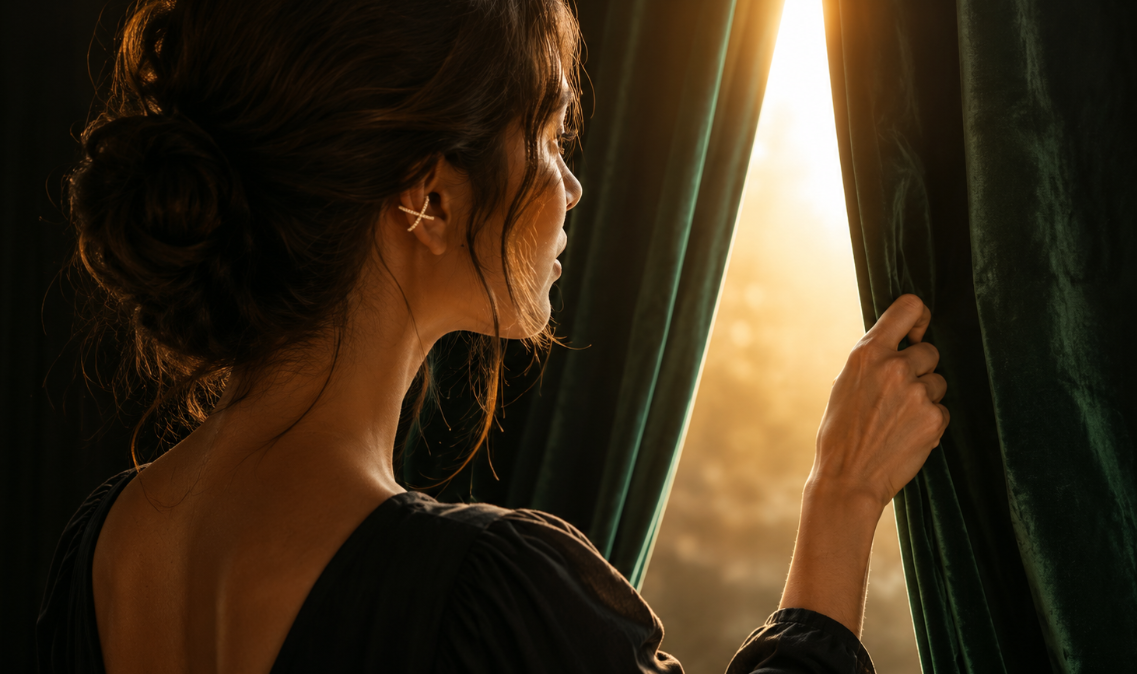
Elphaba isn't cast outside the system because she is wicked or lacks morals. She is cast out because her morals speak so loudly that she cannot help but live by them, even when doing so costs her. She sees what the system is doing and refuses to help maintain the illusion that it's serving the greater good. But her integrity doesn't matter to the system—it's a threat to it. If people could still trust her or hear her perspective, they might begin looking behind the curtain themselves. So her refusal to betray her own values and fall in line is reframed as wickedness. The outsider is created, and then her outsider status is used as proof that she never belonged.
I am not comparing my eighth-grade disciplinary dispute to what Elphaba endured. But the mechanism was not lost on me. I have watched versions of this play out countless times—in families, workplaces, relationships, religion, institutions, and public life. A system establishes the acceptable story. Authority defines what is good. Obedience is rewarded. Questions are tolerated only as long as they do not threaten the structure itself. And when someone refuses to accept the version they are expected to accept, it is often easier to label that person difficult, disrespectful, rebellious, unstable, or bad than it is to face what they are challenging.
That day at school, my classmates were not being encouraged to understand what happened. They were being taught what happened and how they should feel about it. The context was inconvenient because context complicated the moral. If the nun had also behaved inappropriately, then authority could be wrong. If authority could be wrong, then the other children might begin to question it. And if they began questioning it, the entire system would become a little harder to control.
I have spent much of my life questioning the systems and stories we have been handed, so perhaps I understand the witch differently now. I do not want to move through life so invested in belonging or falling in line that I surrender my own ability to see clearly and come to my own conclusions. I do not want to accept something as true—or as simply “the thing we do” or “the next step”—because it is familiar, traditional, popular, or delivered by someone with authority. I want to ask what happened before deciding who someone is, and I want to understand why before accepting what we are expected to do. I want to question the assumptions we treat as facts, the roles we automatically assign to people, and the systems and authority figures we are expected to follow or protect. Because the moment we become more committed to belonging than to seeing clearly, we become capable of protecting almost anything.
Finding your own clarity—and trusting yourself enough to follow it—comes with costs. It requires the willingness to sit through the awkwardness or pain that comes when your questions are viewed as annoying or disobedient—or when asking them places you on the outside. It requires allowing that discomfort, over time, to build the sturdiness needed to keep examining stories and systems without abandoning your curiosity or the morals you have consciously made your own. It also requires questioning yourself, so you do not become so attached to your own perspective that you can no longer recognize when you are wrong. Without that kind of independent thinking, it becomes far too easy to mistake what is familiar, accepted, or expected for what is actually right. When you can distinguish between what violates your values and what merely violates the expectations of a system, you become more willing to accept that belonging may cost more than you are willing to pay. That is its own kind of freedom.
So yes, in the eighth grade, I pushed a nun. That is true. But it is not the whole story—and the whole story matters. Systems and those in positions of authority may exist for good reasons, but neither is inherently right. When they fail, their structure or position should not shield them from accountability; it should demand more of it. Power carries responsibility, and those entrusted with it should be expected to understand both the systems they serve and the consequences of how they use that power.
Whenever a story hands us a villain too quickly, we should get curious about what—or who—that story is protecting.
Ask questions. Pull back curtains. You may find parts of yourself you never would have found by simply accepting the stories you were handed.