There's a centuries-old winter tradition that asks for the exact opposite of what December usually demands from us. It's called Rauhnächte (also spelled Raunächte), pronounced roughly ROW-nekh-tuh, with "row" rhyming with "cow."
In a season that so easily fills with noise, plans, spending, obligations, and expectations, Rauhnächte makes room for something else entirely: stillness, reflection, intention, and a little mystery. It invites us to notice a stretch of time we usually rush through while already looking ahead to whatever comes next.
I first learned about Rauhnächte last year and was drawn to it immediately. Before I share what it looked like in our home, there is a much older story to tell—one shaped by spiritual beliefs, evolving ways of marking time, and customs carried forward over centuries.
With gratitude to Stephanie, who introduced me to Rauhnächte.
A Tradition Between Worlds
The tradition of Rauhnächte has taken many forms over the centuries, particularly across the German-speaking and Alpine regions of Central Europe, including Germany, Austria, Switzerland, and South Tyrol in northern Italy. Its customs vary from place to place, and even the name holds some mystery. One explanation traces the name to the Middle High German rûch, meaning rough, hairy, or shaggy—possibly a reference to the fur-clad figures of regional folklore. Another connects it to Rauch, meaning smoke, reflecting the practice of carrying cleansing smoke through homes and barns.
The calendar adds another layer of mystery. Rauhnächte is often called the Twelve Nights, and one popular explanation connects that name to the roughly eleven-day gap between the lunar and solar years. Traditionally counted as eleven days and twelve nights, this stretch became, in folklore, a period that belonged fully to neither year—a time outside ordinary time. Exactly which twelve nights are observed, however, depends on where you ask. Most commonly today, they begin on Christmas Eve or Christmas Day and conclude with Epiphany on January 6, although some regional traditions begin earlier, around December 20 or 21, near the winter solstice.
A number of customs grew around this in-between time. Some people carried the smoke of herbs and resins through their homes and barns for protection. Others watched the weather and paid closer attention to the events of each night, believing each one might offer clues about its corresponding month in the year ahead. For agrarian communities, certain kinds of work were set aside as the fields rested, gathering strength for the next season.
Yet this slower rhythm did not mean these nights were uneventful. In folklore, the boundary between our world and the spirit world was believed to grow thin, allowing spirits and other supernatural beings to move more freely. One of the most mysterious stories associated with these nights was the Wild Hunt, a ghostly procession said to race across the winter sky. Belief in the Hunt even shaped ordinary household customs. In some places, people avoided hanging laundry outside, fearing the cloth might be swept up by the Hunt and later used as a burial shroud.
Today, many people carry Rauhnächte forward in a more personal way through journaling, dreamwork, wishes, and intentions. Not all of these practices are ancient. Living traditions evolve, and we can honor where they came from while finding our own meaning within them. For my husband and me, that meaning began with a small stack of paper and thoughtful intentions.
The Thirteen Wishes
There are many ways to observe Rauhnächte: cleansing your home with smoke, recording dreams and daily reflections, or simply spending a quiet evening by candlelight and noticing what surfaces. My husband and I were most drawn to the thirteen-wishes ritual, which balances surrender with personal responsibility.
We each wrote thirteen wishes for the coming year, folded them so they couldn’t be read, and set them aside. On each of the twelve nights, we drew one at random and burned it without opening it, reminding ourselves that we could keep working toward what we wanted without needing to control every detail. By the end, one wish remained for each of us—the one we would actively nurture in the year ahead. As someone who readily admits to being a control freak, I appreciated that the ritual did not ask me to give up all control—only to be more thoughtful about where I placed it. This is what the ritual looked like in our home:
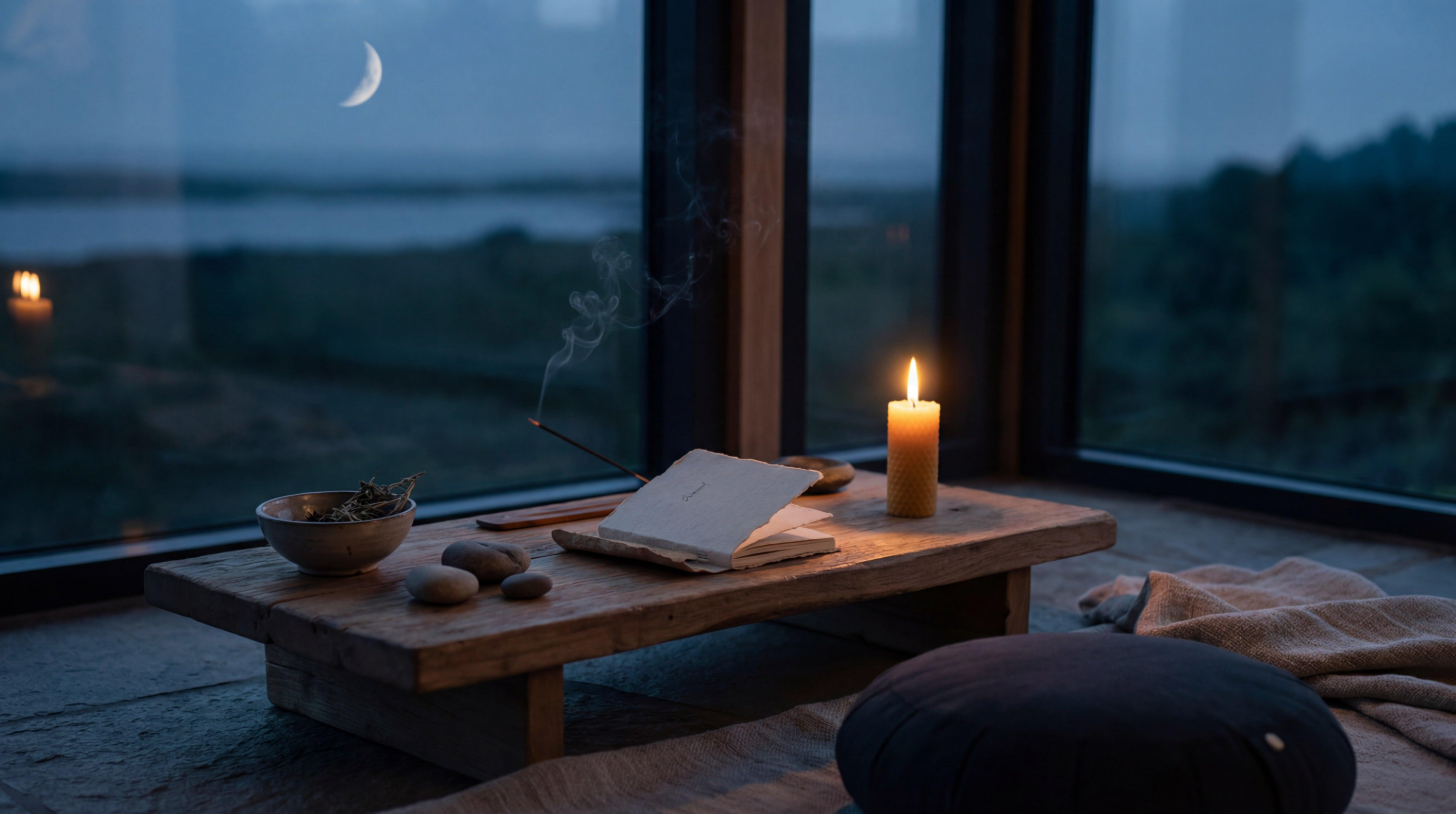
Prepare. On December 24, we waited until dinner was finished, the kitchen was clean, and nothing more was required of us. We played soft instrumental music, lit candles, burned incense, poured our beverages of choice—mine was hot tea—and sat together with pens, paper, and two small bowls.
Reflect. Before writing, we looked back over the year. What felt good? What had become heavy? What did we wish we had handled differently? What were we ready to release, and what did we want to make room for? Reflecting first helped us connect with what felt most meaningful.
Write. We each wrote thirteen wishes or intentions, one per slip of paper. The version we followed asked us to write in the present tense, as though they were already true. We kept each one personal and clear, centered on the experience we wanted without dictating exactly how it had to happen or making its fulfillment depend on someone else. For example, the wish that remained for me was: I feel at home in the world and trust myself to choose what comes next.
Burn. Each evening from December 25 through January 5, we chose one folded wish without opening it and burned it in a fire-safe bowl. Burning each wish unopened was an act of surrender, but we did not take surrender to mean becoming passive. We would still do what we could to create the conditions for our wishes to take form without insisting on exactly how we had to get there. For a few minutes each night, we practiced letting go of the need to plan, manage, or control what came next.
Keep. On January 6, we each opened the one wish that remained. Unlike the twelve we had released, our final wishes stayed in our hands. Before beginning this year’s Rauhnächte, we plan to sit down together and talk about how they showed up in our lives, what we did to support them, and what they taught us.
That balance is what made the thirteen-wishes ritual so meaningful to me. We named what we wanted and practiced taking responsibility for what we could shape while releasing our need to control the rest.
A Final Thought—and a New Rhythm
Releasing control and choosing stillness are not the same as doing nothing. When we loosen our hold on expectations and pause new input, our minds have room to process—to sort, settle, and catch up. Perhaps that is why quiet can matter so much when life is asking the most of us.
That kind of quiet feels especially valuable now. As we move deeper into the final quarter—a stretch of the year that somehow seems to disappear faster than the rest—I’ve found myself looking forward to this year’s Rauhnächte and reflecting on what I want to work toward and what I am ready to release.
That reflection has made several things clear to me. One is that I am ready to change my writing rhythm and become more intentional about what I share, how I share it, and when. I am not stepping away from writing. I’m making room for something deeper—longer-form work and greater alignment among my writing, continued learning, and coaching, all centered on the relationships and patterns I most want to explore. That means releasing both the monthly cadence and the expectation that there must always be a next post. I may still return here when it feels meaningful, but I am letting go of the schedule.
To everyone who has read, reached out, shared my work, or quietly carried something from it over these past two years: thank you. Writing can be solitary, but sharing it with you has made it feel like a conversation—one that has helped me grow, too. That has meant more than I can adequately express.
As I close both this year and this chapter of monthly writing, I leave you with the same invitation Rauhnächte has offered me: step outside the usual rhythm long enough to hear what becomes clearer in the stillness.
Whatever this season looks like for you, I hope you find a few quiet nights of your own—nights that help you recognize what you are ready to release, what deserves to come with you, and how you want to meet the year ahead.
Stay curious and keep becoming.